Enterprise RAG AI Assistant
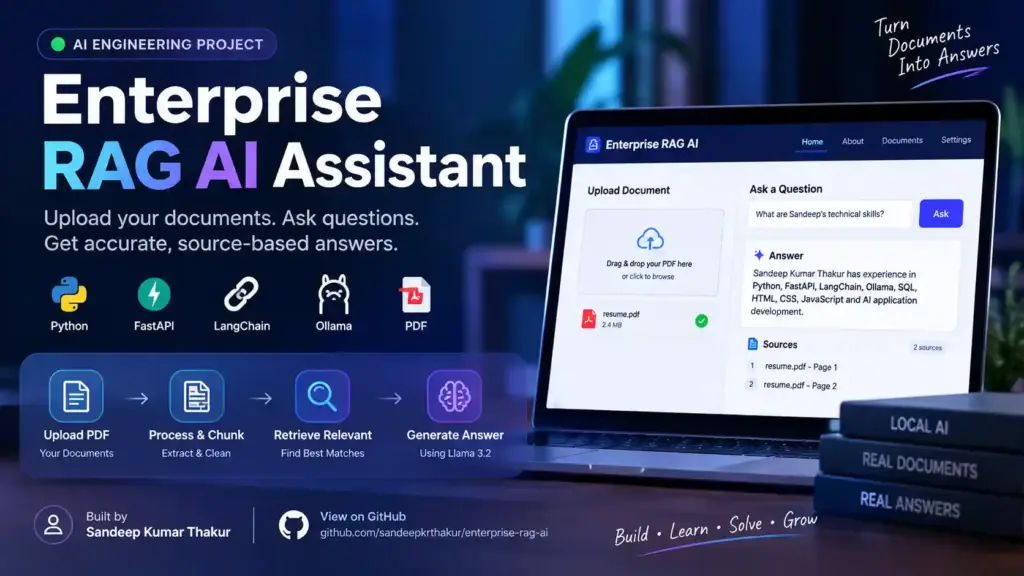
Enterprise RAG AI Assistant
A document intelligence system that lets users upload PDFs, retrieve relevant knowledge and ask questions using Retrieval-Augmented Generation powered by Python, FastAPI, LangChain and Ollama.
Why I built this project.
Traditional chatbots can answer general questions, but they do not automatically understand a company’s private documents. This project demonstrates how I built a document-grounded AI assistant that answers questions using uploaded knowledge.
🎯 The Problem
Organizations often store valuable information inside PDFs, reports, resumes, policies and internal documents. Finding a specific piece of information manually can be slow and inefficient.
💡 The Solution
I created an end-to-end RAG pipeline where documents are extracted, cleaned, divided into chunks, searched for relevant content and supplied to a local LLM as context before generating the final answer.
What the final system can do.
The completed application combines document processing, retrieval and local AI into a simple web interface.
PDF Knowledge Upload
Upload PDF documents and automatically process their text into searchable knowledge chunks.
Relevant Retrieval
Search the uploaded knowledge base and identify the most relevant document sections for a question.
AI Answer Generation
Use a local Llama model through Ollama to generate answers grounded in retrieved document context.
Source References
Return the source filename and page information used to construct the answer.
FastAPI Backend
Expose document upload, search and question-answering functionality through API endpoints.
Local AI Processing
The application can use Ollama locally, reducing dependency on external hosted model APIs.
How I built the system.
I built the application step-by-step, starting with document ingestion and gradually connecting retrieval, AI generation and the user interface.
Project Setup
Created the Python project structure, virtual environment, dependencies and FastAPI application.
PDF Processing
Used pypdf to extract text from uploaded PDF files and cleaned the extracted content before processing.
Document Chunking
Large documents were divided into smaller overlapping chunks so that relevant sections could be retrieved efficiently.
Retrieval Layer
Implemented relevance-based document search to identify the most useful chunks for the user’s question.
Local LLM Integration
Connected LangChain with Ollama and the Llama 3.2 model to generate responses from retrieved document context.
Source-Aware Answers
Added source metadata including document filename and page number so users can understand where the answer came from.
Frontend Interface
Built a responsive web interface for uploading PDFs, asking questions and displaying answers and sources.
Inside the Enterprise RAG pipeline.
The application separates document ingestion, retrieval, AI generation and presentation into clear stages.
How a question becomes an answer.
The engineering behind it.
The core implementation focuses on clean document processing, retrieval and controlled LLM prompting.
The application in action.
The final interface provides a simple workflow: upload a document, ask a question and inspect the AI-generated answer with sources.
Tech stack I used.
A lightweight Python-based stack designed around retrieval-augmented generation and local AI.
Problems I solved during development.
PDF Processing
PDF text extraction can produce inconsistent spacing and formatting. I added a cleaning layer before chunking the document.
Context Retrieval
The model should not receive the entire document. I implemented chunking and relevance-based retrieval to provide focused context.
Hallucination Control
The prompt explicitly instructs the model to answer using document context and state when information cannot be found.
Source Traceability
Each document chunk carries filename and page metadata, allowing the final API response to expose source pages.
API Integration
The frontend communicates with FastAPI endpoints for document upload, processing and question answering.
Local AI Runtime
Ollama provides a local model runtime, allowing the application to demonstrate private document processing without relying entirely on a hosted LLM API.
What this project demonstrates.
What I learned from building it.
🧠 AI Engineering
This project helped me understand how an LLM application works beyond simply calling an AI API. I worked with document ingestion, retrieval, context construction, prompt design and source attribution.
⚙️ Backend Engineering
I gained practical experience connecting a Python processing layer, FastAPI endpoints, local LLM inference and a responsive frontend into one working application.
Try the Enterprise RAG AI Assistant
Upload a document and ask questions against your own knowledge base using the RAG pipeline I built.